 Frontly
Voice AI Demo Sounds Great — Here's Why the Real Call Won't
Most voice AI vendors demo on web calls. Your patients call on mobile. Here's the technical gap they're not showing you — and the one question to ask before you sign.
You've probably sat through a voice AI demo that impressed you. The agent sounded natural. Responses were fast. It handled the patient's question cleanly and booked the appointment. You thought: this could actually work.
Then you signed. And the first week of real calls felt different. The voice was slightly off. There was a beat of delay you hadn't noticed before. A patient repeated themselves twice. Your receptionist flagged it.
If that's happened to you — or if you're about to evaluate a voice AI vendor and you want to avoid it — this piece explains exactly what's going on, and gives you the one question that separates vendors who've solved it from vendors who haven't.
The short answer: Most voice AI vendors demo on web-based calls, where audio quality is high and latency is low. Your patients call your clinic on mobile networks, where the physics are fundamentally different. The gap between those two environments is where most voice AI deployments fail — quietly, expensively, and after you've signed a 12-month contract.
The Technical Gap Nobody Explains Before You Sign
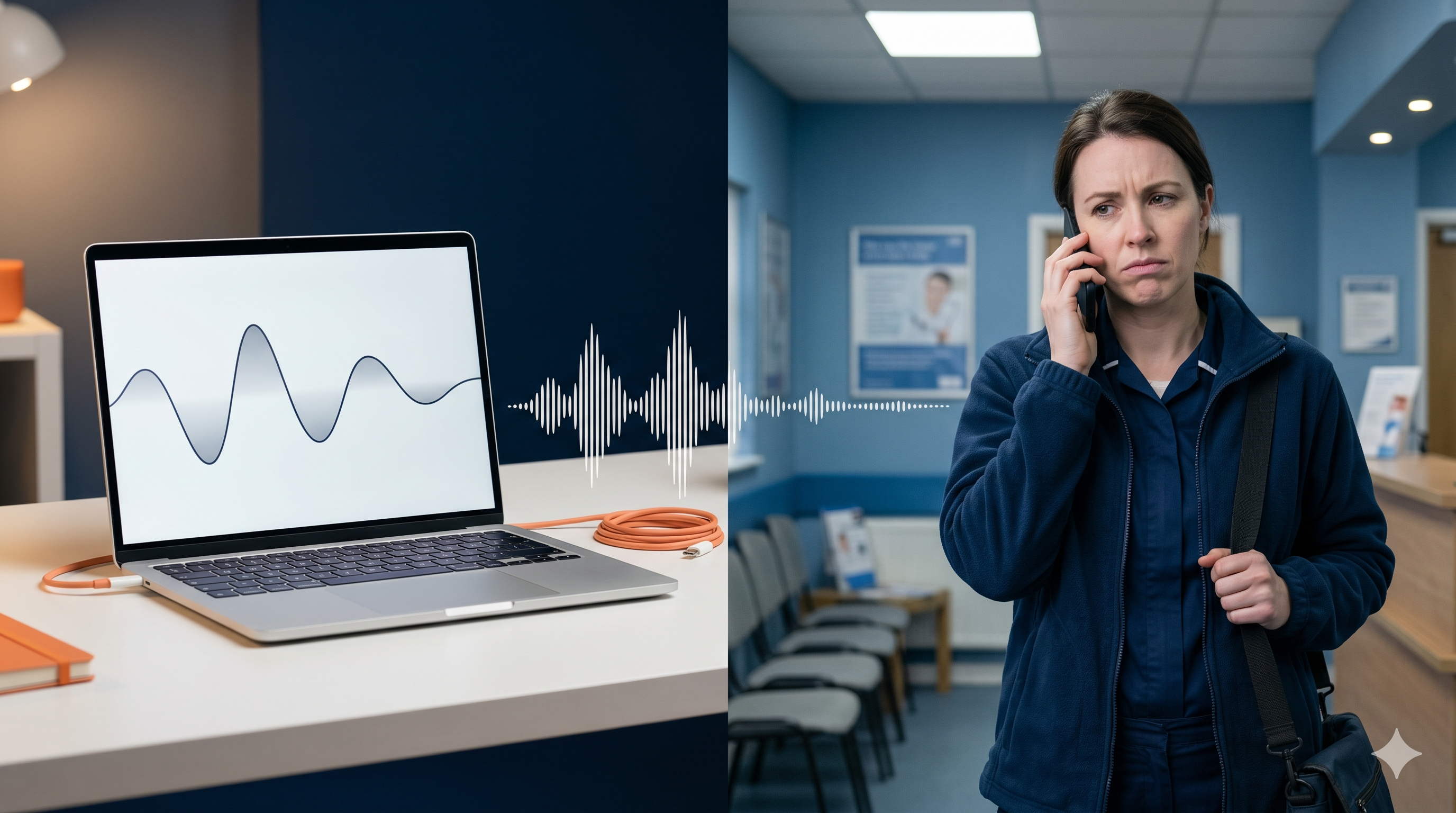
When a voice AI system runs on a web-based environment — the kind used in most demos — it operates at an audio frequency of around 16,000 Hz. That's close to what your ear hears in a real conversation. Nuance, tonality, the natural rhythm of a voice — all of it comes through. The demo sounds like a person.
When your patient calls your clinic on their mobile phone, the call travels over the standard telephony network. That network supports a maximum audio frequency of 8,000 Hz. Half the bandwidth. The nuance is gone. The tonality flattens. A voice that sounded warm and natural on a web demo can sound slightly robotic, slightly hesitant, or slightly wrong on a real mobile call.
You've actually experienced this yourself. Think about the difference between how your own voice sounds on a WhatsApp call versus a regular phone call. WhatsApp runs over internet data — high bandwidth, high frequency. A standard phone call runs over the telephony network — 8,000 Hz ceiling, no exceptions. That's not a settings issue. That's physics.
The Latency Problem Is Separate — And Solvable
On a web-based call, latency — the delay between a patient finishing a sentence and the agent responding — is naturally low. On a mobile network, you add signal conditions, network congestion, and the inherent delay of telephony infrastructure. Without architectural work to address this, you get a voice agent that pauses too long, sounds like it's thinking, and breaks the natural rhythm of a conversation. Patients hang up. Or they ask for a human.
The solution is engineering. At Frontly, we use WebSocket streaming over properly benchmarked telephony systems. We evaluated Twilio, Plivo, and Exotel — and identified which perform best under real mobile network conditions. WebSocket streaming means voice data travels as a continuous stream rather than discrete packets, minimising the impact of network variability.
We've also orchestrated the four internal channels any voice AI runs on — speech-to-text, text-to-speech, the language model, and the telephony connection — so handoff time between each is optimised. The result isn't zero latency. Nothing is. But it's latency that feels like a normal human conversation — not a satellite call.
The Voice Quality Problem Is Also Solvable — But Most Vendors Don't Bother
The 8,000 Hz ceiling on telephony is a hard constraint. What you can do is choose and train voices specifically for how they perform on that network — not in a browser. We discovered through actual testing with real patients and clinic staff that a voice that sounds excellent in a web environment does not automatically sound excellent over a phone call.
So we ran manual experiments. Multiple voice options, run through actual telephony calls with real audiences. We identified which voices held up — sounding most natural, most trustworthy, most appropriate for a healthcare context — specifically on mobile. That's the voice that goes into a Frontly deployment.
Most voice AI vendors pick a voice that sounds good in the demo environment and move on. The clinic finds out it sounds different in production. By then, the contract is signed.
The One Question to Ask Any Voice AI Vendor Before You Sign
"Can you call my mobile right now — not a browser call, my actual mobile number — and show me what your agent sounds like on the telephony network?"
That's it. That's the test.
A vendor who has built for real telephony conditions will say yes without hesitation. A vendor who hasn't will find a reason it's not possible right now, or offer to send you a recording, or explain that the quality difference is minimal.
The recording is not the same thing. A recording played back through your browser is a web-based audio file — it has none of the telephony constraints. You need to hear it on your phone, on your network, in real time.
When we demo Frontly, we call the prospect's mobile. Mid-demo, live. They pick up and hear the agent. That's the voice their patients will hear. No gap between demo and production.
What This Means for a Multi-Location Dental Practice
If you're running three or more locations, the stakes are higher. You're handling call volumes a single receptionist team can't absorb, fielding calls across locations with different patient demographics and appointment types. All of that falls apart if voice quality is poor enough that patients don't trust the agent, or latency is high enough that they hang up before they've been qualified.
The missed-call problem you're trying to solve — leads leaking after 6 PM, weekends, across locations — gets worse, not better, if the agent you deploy sounds wrong on a mobile call.
The Honest Summary
There are three things a voice AI vendor needs to have solved for telephony to work properly in production:
- Telephony infrastructure — Twilio, Plivo, Exotel or equivalent — using WebSocket streaming to minimise latency under real mobile network conditions.
- Internal orchestration of the four system channels (speech-to-text, text-to-speech, LLM, telephony) so handoff latency between them is minimised.
- Voices selected and trained specifically for telephony performance — not web performance.
If a vendor can't show you evidence of all three, ask them to call your mobile before you sign anything.
Frontly is GDPR compliant with UK-hosted data residency. Our current active markets are UK, US, Canada Australia, and India.